By Hiran, CIMA (ACMA, CGMA). 8+ years reconciling accounts across Australia, the UK, the US and Canada
“Monthly” is the answer you’ll get almost everywhere, and it’s not wrong. It’s just incomplete. Monthly is the floor, not the target. I’ve got clients for whom monthly reconciliation is genuinely more than enough, and clients for whom it’s letting a real problem sit unnoticed for three or four weeks longer than it needs to. The right frequency depends on how many transactions move through each account, how much cash risk is involved, and (something almost nobody mentions) how often your country actually requires you to report.
This guide gives you a specific answer instead of a vague one: a way to place your own business on a simple grid, a worked example showing exactly what an extra three weeks of delay costs in practice, and a look at how Australia’s BAS cycle, the UK’s Making Tax Digital rollout, Canada’s GST/HST filing thresholds, and US quarterly estimated taxes each quietly set a minimum cadence of their own.
The Short Answer, and Why It’s a Floor, Not a Target
Reconcile every account (every bank account, every credit card, every payment processor) at least monthly, full stop. If you need the mechanics of a single reconciliation itself, see step-by-step guide to How to Reconcile a Bank Statement. That’s the floor below which errors start compounding faster than you can realistically catch them. Above that floor, the right frequency is a judgement call based on transaction volume and cash risk, not a single number that applies to every business. A sole consultant invoicing eight clients a month and a Shopify store processing forty orders a day have no business reconciling on the same schedule, even though both are “small businesses.”
What Actually Determines How Often You Should Reconcile
Transaction Volume
More transactions means more chances for a duplicate, a miscategorisation, or a missing entry, and a backlog is harder to untangle the longer it sits. As a rough guide from practice: once an account is regularly clearing more than about 100-150 transactions a month, a single monthly session stops being a quick check and starts being an hour-plus forensic exercise. That’s the point to consider moving that account to weekly.
Cash and Fraud Risk
Volume isn’t the only variable. A business handling physical cash (a café, a salon, a market stall) carries a different risk profile even at low transaction counts, because cash is the easiest thing to lose track of and the hardest to trace after the fact. The same goes for any account with several people authorised to spend from it, where an extra pair of eyes catching an error quickly matters more than the raw transaction count would suggest.
How Many Accounts You’re Running
Every additional bank account, credit card, or payment processor is one more place an error can hide, and one more reconciliation to actually do. A business running its chequing account, a savings account, a company credit card, and a Stripe or PayPal balance has effectively four reconciliations each cycle, not one, and they can drift out of sync with each other even when each one individually looks fine. Accounts receivable and accounts payable are subledgers with their own reconciliation rhythm too, not just bank and card balances: see our guide to Reconciling Accounts Receivable and Payable for how often to check those specifically.
Your Statutory Filing Cycle
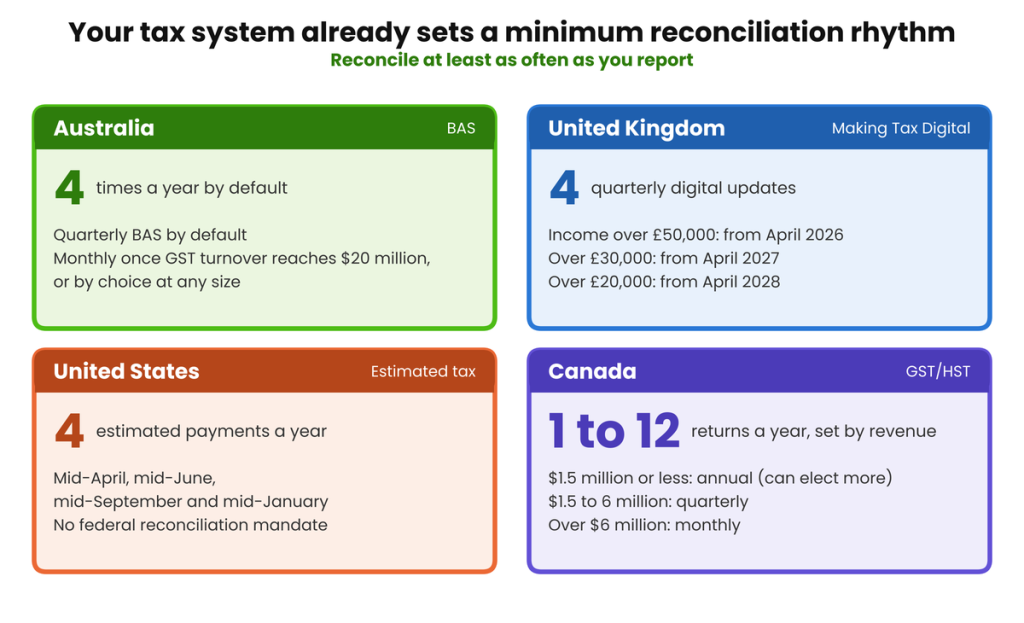
This is the factor most reconciliation advice skips entirely, and it shouldn’t: in every one of these four countries, something in the tax system already sets a cadence for you, whether you’ve thought about it or not.
| Country | What sets the cadence | Practical tie-in |
| Australia | BAS is lodged quarterly by default; monthly becomes mandatory once GST turnover reaches $20 million, and any business can elect monthly voluntarily | If you’re on quarterly BAS, reconcile at least monthly anyway: waiting until the BAS is due to reconcile three months of transactions in one sitting is how errors get missed under deadline pressure |
| United Kingdom | Making Tax Digital for Income Tax requires quarterly digital updates from HMRC, mandatory from April 2026 for income over £50,000, April 2027 over £30,000, and April 2028 over £20,000 | For anyone caught by MTD, quarterly reconciliation stops being best practice and becomes close to a legal minimum: you can’t file an accurate quarterly update from books that aren’t reconciled |
| United States | No federal reconciliation mandate, but quarterly estimated tax payments fall in mid-April, mid-June, mid-September and mid-January | Reconciling in the weeks before each estimated payment is due gives you a real profit figure to base the payment on, instead of a guess |
| Canada | GST/HST filing frequency is assigned by revenue: $1.5 million or less defaults to annual (monthly or quarterly can be elected), $1.5-6 million is assigned quarterly, and over $6 million is assigned monthly | Whatever frequency the CRA has assigned you, reconcile at least that often: filing a GST/HST return from unreconciled books risks reporting a number you’ll need to correct later |
A Practical Frequency Guide
Two questions get you most of the way to the right answer for your specific business: how many transactions move through an account each month, and how much cash or fraud risk is involved. Plot your business on both and read off the recommendation.
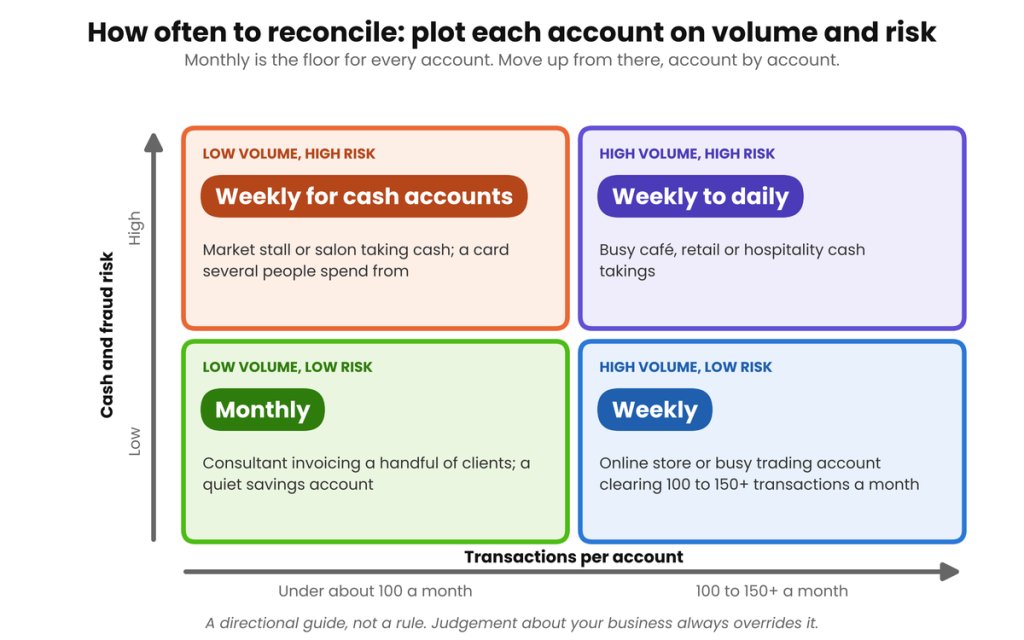
A directional guide, not a rule: judgement about your specific business always overrides it.
| Business profile | Frequency | Why |
| Low-volume service business, one bank account | Monthly | Matches most countries’ default filing cycle; more frequent reconciliation adds little value at this volume |
| Multiple accounts (chequing + card + Stripe/PayPal) | Monthly per account, reviewed together | Cross-account errors (a payout that hits one account but not the other) are often only visible when you look at all of them side by side |
| E-commerce or other high-transaction business (100+/month) | Weekly | A month’s backlog on a high-volume account takes disproportionately longer to untangle than four weekly sessions of the same total volume |
| Cash-handling business (retail, hospitality) | Weekly to daily for cash accounts | Cash is the fastest account type to lose track of and the hardest to trace after the fact |
| Multi-entity or intercompany structure | Monthly, tied to month-end close | See our Month-End Close Checklist for Small Business and Reconciling Multi-Entity Group Accounts: A Framework: frequency matters less here than doing it in the right order |
A Worked Example: Larkspur Home Goods
Larkspur Home Goods runs a Shopify store selling home décor, processing roughly 1,100-1,300 orders a month through Shopify Payments, with a separate business chequing account for expenses. Through September 2026, the business reconciled monthly, as it always had.
On 8 September, a refund was issued to a customer and, due to a timing glitch between Shopify’s payout batching and the refund itself, the same $215.00 amount was deducted from two separate payouts instead of one. Nobody caught it until the monthly reconciliation on 30 September, 22 days after it happened, and well after the transactions around it had been forgotten in any specific detail.
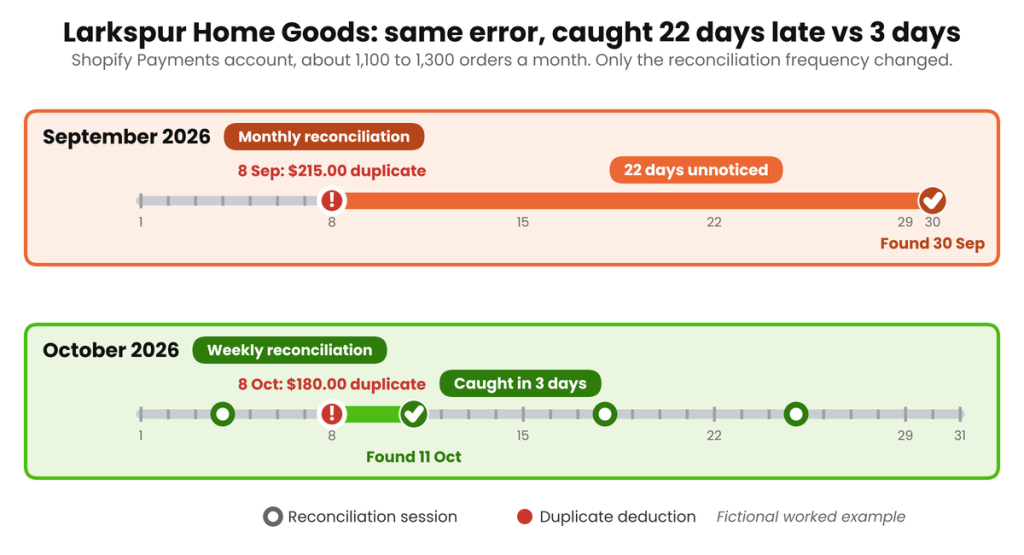
Illustrative concept from a fictional worked example, not drawn from a real client’s records.
Starting in October, Larkspur switched that account to weekly reconciliation, same total volume, just reviewed in four sittings instead of one. A near-identical error (a $180.00 duplicate deduction) occurring on 8 October was caught at the very next weekly session, on 11 October: 3 days later, not 22. Nothing else about the business changed. The only variable was how often someone looked.
| Why frequency matters more than it seems: The ACFE’s Occupational Fraud 2026 report found a median fraud scheme runs about 12 months before it’s caught. Most reconciliation gaps aren’t fraud (they’re duplicate charges, missed fees, or a typo), but the same logic applies either way: the less often you reconcile, the longer a genuine problem sits unnoticed, and the harder it is to remember why a three-month-old transaction looks the way it does. |
How Far Behind Is Too Far Behind (and How to Catch Up)
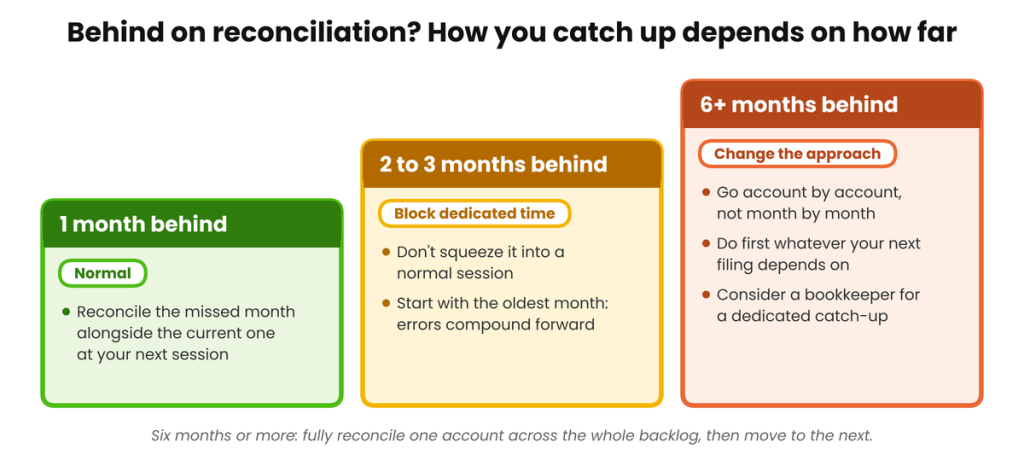
- One month behind is normal and not worth panicking about: reconcile the missed month alongside the current one at your next scheduled session.
- Two to three months behind means it’s worth blocking dedicated time rather than trying to squeeze the catch-up into a normal session: start with the oldest unreconciled month first, since errors compound forward, not backward.
- Six months or more behind changes the approach entirely: work through it account by account rather than month by month. Fully reconcile one account across the whole backlog before moving to the next, rather than trying to close every account for a single month before moving to the next month. It’s easier to hold one account’s logic in your head across six months than six accounts’ logic in your head for one month.
- If you’re this far behind and a filing deadline (BAS, VAT return, GST/HST return, quarterly estimated tax) is approaching, prioritise whichever account and period that filing actually depends on, and treat the rest as important but not that week’s emergency.
- A backlog beyond about six months, especially across multiple accounts, is usually cheaper to hand to a bookkeeper for a dedicated catch-up engagement than to absorb into normal working hours alongside everything current. The hourly cost is rarely the expensive part; the opportunity cost of everything else that slips while you’re buried in old bank statements is.
Does QuickBooks Online or Xero Enforce a Frequency?
Neither platform enforces how often you reconcile: that discipline is procedural, not technical. Both will happily let months of unreconciled transactions accumulate without any warning beyond a growing number of unmatched bank feed items sitting in the background. What they do offer is a reconciliation status indicator on the relevant account screen, so at a glance you can see the date of your last completed reconciliation for that account, worth checking deliberately rather than assuming it’s more recent than it is.
Where This Actually Goes Wrong
A few habits show up again and again in practice, and a few signs reliably mean your current frequency has stopped being enough. If any of these point to an actual mismatch once you’re reconciled, our guide to Common Reconciliation Discrepancies, and How to Fix Them covers how to trace one down.
The Habits Worth Breaking
- Applying one frequency to every account, when a low-volume savings account and a high-volume trading account genuinely warrant different schedules.
- Treating “monthly” as a target rather than a floor, for a business whose transaction volume or cash risk has grown past the point monthly still makes sense.
- Waiting until a BAS, VAT return, or GST/HST filing is due to reconcile the whole period in one sitting, under deadline pressure.
Signs Your Current Frequency Isn’t Enough
- Every reconciliation session takes noticeably longer than the last one, even though the business hasn’t grown much, a sign the backlog between sessions has quietly grown too.
- You regularly can’t remember the specific reason for a transaction by the time you get to reconciling it.
- Errors are consistently caught a month or more after they happened, rather than within the same week or two.
- You’ve had to redo a filing (BAS, VAT return, GST/HST return) because an error was found after it was submitted.
- A specific account (usually the one with the most transactions or the most cash exposure) is always the one causing problems, while the others stay clean.
Reconciliation Frequency Checklist
| ☐ | List every bank account, credit card, and payment processor the business uses |
| ☐ | Estimate monthly transaction volume for each one |
| ☐ | Flag any account with meaningful cash-handling or fraud risk |
| ☐ | Set each account’s frequency individually: don’t default to one schedule for all |
| ☐ | Confirm your country’s statutory filing cadence and reconcile at least that often |
| ☐ | Put reconciliation sessions on a recurring calendar reminder, not an ad hoc basis |
| ☐ | Check the reconciliation-status date in your software each session |
| ☐ | If behind more than two months, switch to an account-by-account catch-up plan |
FAQs
How often should a small business reconcile its books?
At least monthly for every account, as a floor. Businesses with higher transaction volume (roughly 100-150+ transactions a month per account) or meaningful cash-handling risk are usually better served reconciling weekly, or even daily for cash-heavy accounts.
Is monthly reconciliation actually enough?
For a genuinely low-volume business with one or two accounts, yes. For a business processing high transaction volumes or handling significant cash, monthly is the legal and practical minimum, not the ideal: errors sit unnoticed longer and backlogs take disproportionately longer to untangle.
Does my country’s tax system affect how often I should reconcile?
Yes, more than most advice acknowledges. Australia’s BAS is quarterly by default, the UK’s Making Tax Digital is phasing in mandatory quarterly digital updates from April 2026, Canada assigns GST/HST filing frequency by revenue, and US quarterly estimated tax payments create a natural four-times-a-year checkpoint. Reconcile at least as often as you’re required to report.
What’s the difference between weekly and monthly reconciliation in practice?
The mechanics are identical; the difference is how much backlog accumulates between sessions. A monthly session on a high-volume account can mean reviewing 1,000+ transactions at once and tracing an error back through weeks of activity; a weekly session on the same account means reviewing roughly a quarter of that each time, with issues caught within days rather than weeks.
I’m several months behind on reconciliation. Where do I start?
Once you’re more than two or three months behind, switch from a month-by-month approach to an account-by-account one: fully reconcile your most important account across the entire backlog before moving to the next account, rather than trying to close every account for one month before moving on.
Do QuickBooks Online or Xero remind you to reconcile?
Neither platform actively pushes a reminder if you fall behind. Both show a reconciliation-status date on the relevant account screen, but you have to check it deliberately; it’s not something that surfaces on its own.
Should every bank account and credit card be reconciled on the same schedule?
Not necessarily. A low-volume savings account and a high-volume trading account, or a card several people can spend from, don’t carry the same risk profile. It’s reasonable and often more efficient to set frequency per account rather than applying one blanket schedule to the whole business.
Larkspur’s $215.00 and $180.00, 22 Days Apart Versus Three
Larkspur Home Goods’s $215.00 duplicate deduction and $180.00 near-repeat weren’t different kinds of error. They were the same kind of ordinary mistake, caught 22 days apart the first time and 3 days apart the second, purely because of how often someone looked. Monthly is a defensible floor for a genuinely low-volume, low-risk business, and an increasingly weak one for anything busier than that. Match your frequency to your actual transaction volume, your cash risk, and whatever your country already requires you to report, and reconciliation stops being the task that occasionally surfaces a three-week-old surprise.
| About the Author Hiran is a CIMA-qualified bookkeeper (ACMA, CGMA) with 8+ years of experience reconciling accounts, including multi-entity and intercompany reconciliations, for small businesses across Australia, the UK, the US and Canada. He runs a bookkeeping practice working directly in QuickBooks Online and Xero for clients in hospitality, e-commerce, agencies and professional services. |