By Hiran, CIMA (ACMA, CGMA). 8+ years reconciling accounts across Australia, the UK, the US and Canada
Two related entities are manageable with a notebook and a good memory. Three or four start to strain that. By the time a group has a holding company, an operating subsidiary or two, and maybe a manufacturing or property entity on the side, “just check the numbers agree” stops being a sensible instruction. There are too many pairs of books, too many relationships between them, and no obvious order to work through it all in.
This is the framework I actually use for that: a repeatable, six-step process for reconciling a small group’s accounts every month, from each entity’s own books through to one trustworthy consolidated view. It assumes you’ve already got the fundamentals in place. If you haven’t, our companion guides on bank reconciliation and intercompany reconciliation cover those in detail. This guide is the layer on top: what changes once you’re not reconciling one relationship, but a whole group of them at once.
What a Multi-Entity Reconciliation Framework Actually Needs to Do
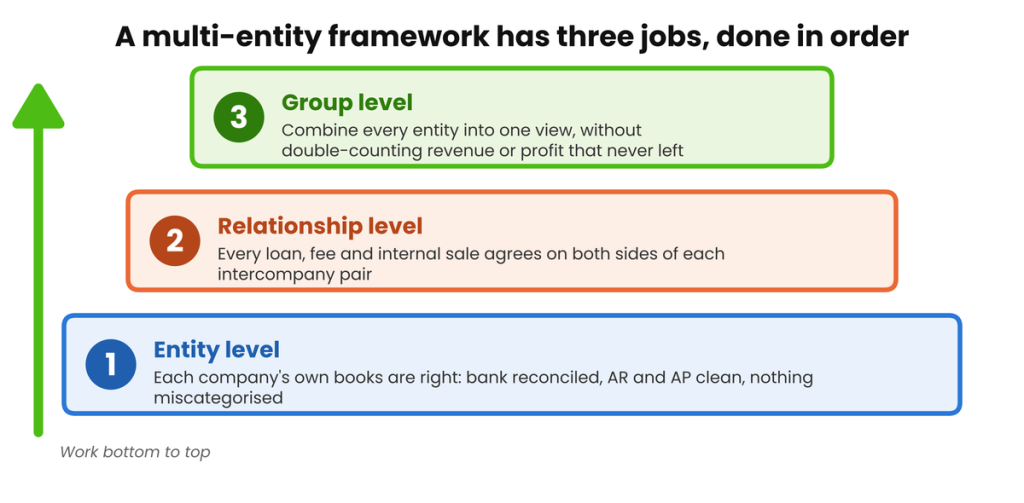
A group company reconciliation process has three jobs, and most of the frustration with multi-entity bookkeeping comes from trying to do all three at once instead of in order:
- Confirm each entity’s own accounts are correct on their own terms: bank reconciled, AR and AP clean, nothing miscategorised.
- Confirm every relationship between entities agrees on both sides: loans, management fees, and any goods or services sold internally.
- Combine the group into one view that means something, without double-counting revenue, expenses, or profit that never actually left the group.
Skip the first job and the second and third are built on sand. Skip the second and the group total will be wrong even if every individual entity looks perfect. Skip the third and you’ve done all the reconciliation work but still can’t answer “what did the group actually make this month?” with a straight face.
The Multi-Entity Reconciliation Framework, Step by Step
We’ll walk through this with a worked example: the Fernbridge Group, made up of Fernbridge Holdings Pty Ltd (“Holdco”), Fernbridge Manufacturing Pty Ltd (“Manufacturing”), and Fernbridge Retail Pty Ltd (“Retail”), closing their books for August 2026. The figures are illustrative, not a real client’s, but the structure and the method are exactly how a real small group’s reconciliation runs.
Step 1: Standardise the Chart of Accounts Across Every Entity
Before anything else, every entity in the group should use the same account structure and, ideally, the same account names and numbering. If Holdco calls an account “Management Fee Income” and Manufacturing calls the matching expense “Admin Recharge”, someone has to remember that mapping every single month, and eventually, someone won’t. A shared chart of accounts turns “compare these two entities” from a translation exercise into a straightforward line-by-line check.
This is a one-off setup cost, not a monthly task, which is exactly why it’s worth doing properly the first time rather than patching account names as you go. If your group is already past this point with inconsistent charts of accounts, it’s still worth fixing: the earlier you standardise, the less historical data you have to reconcile between two different naming conventions.
Step 2: Reconcile Each Entity on Its Own First
Every entity’s own accounts need to be clean before you touch anything at group level: bank accounts reconciled to the statement, AR and AP up to date, nothing sitting in a miscellaneous or suspense account. This is ordinary single-entity bookkeeping, covered in full in How to Reconcile a Bank Statement, Step by Step, and it applies separately to Holdco, Manufacturing and Retail: three entities means three complete bank reconciliations, not one.
It’s tempting to skip straight to the group-level questions because they feel more urgent, but an unreconciled bank account inside one entity will eventually show up as an unexplained variance at group level, and by then it’s much harder to trace back to its source.
Step 3: Reconcile Every Intercompany Relationship
The Fernbridge Group has three intercompany relationships to check every month: Holdco charges a management fee and carries a loan balance with each of Manufacturing and Retail, and Manufacturing sells finished stock to Retail at a markup. Each of these gets reconciled the same way: pull the closing balance from both entities’ books, confirm they mirror each other exactly, and investigate anything that doesn’t. The full method, including a worked numeric example, is in What Is Intercompany Reconciliation, and Why It Matters.
For August, Holdco’s loan and management fee accounts with both subsidiaries reconciled cleanly with no adjustment needed. The one relationship that needs closer attention this month is the stock transfer between Manufacturing and Retail, which is where Step 4 comes in.
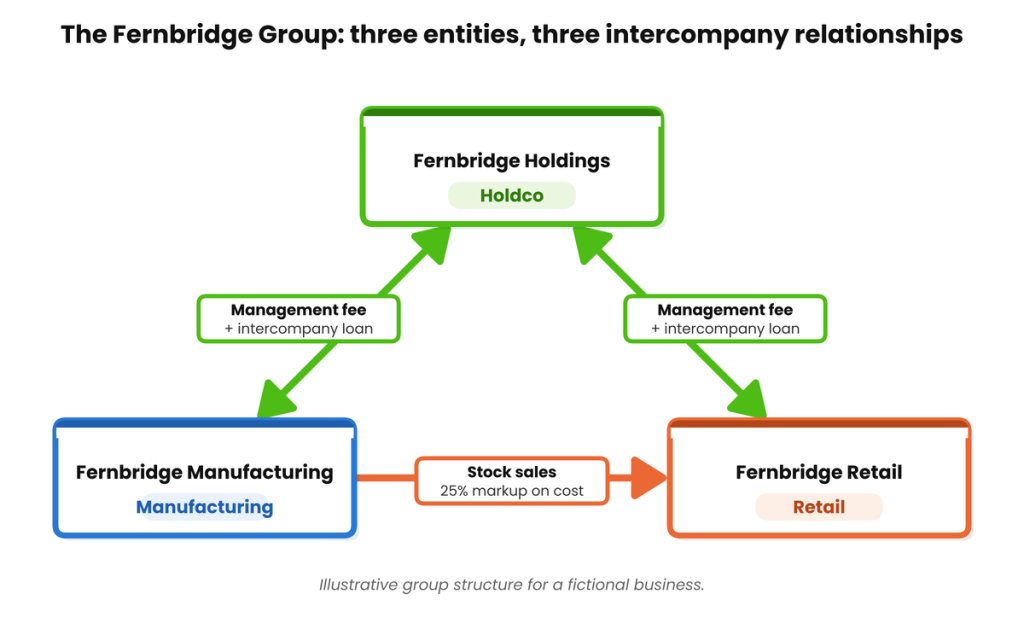
The Fernbridge Group’s structure and its three intercompany relationships. Illustrative, not a real client’s.
Step 4: Flag Intercompany Profit Sitting in Unsold Stock
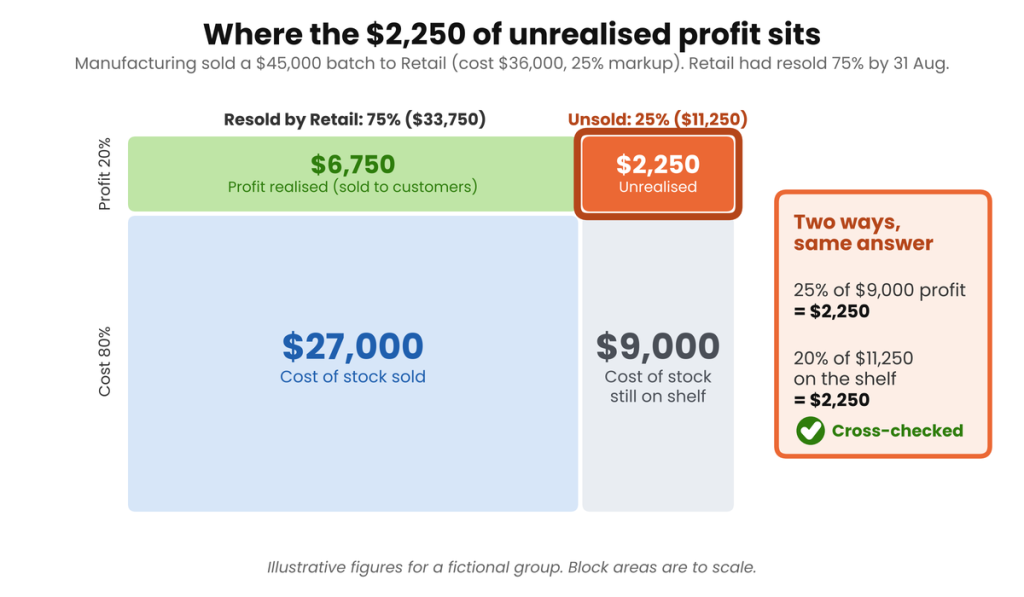
This step only applies if entities in your group sell goods or services to each other at a markup. Not every small group will hit it, but manufacturing-and-retail structures like Fernbridge’s often do. In August, Manufacturing sold a batch of finished stock to Retail for $45,000. Manufacturing’s cost to produce that batch was $36,000, so the sale carried a 25% markup on cost and $9,000 of profit.
By 31 August, Retail had resold 75% of that batch to outside customers and still had the remaining 25%, $11,250 at the price Retail paid Manufacturing, sitting on its shelves. From the group’s point of view, that unsold 25% still belongs to the group, not to a customer, so the profit embedded in it hasn’t actually been earned yet. That’s the number worth calculating:
| Transfer price, Manufacturing to Retail | $45,000.00 |
| Manufacturing’s cost to produce the batch | $36,000.00 |
| Profit on the intercompany sale (25% markup on cost) | $9,000.00 |
| Portion of the batch still unsold by Retail at 31 Aug | 25% ($11,250.00) |
| Unrealised profit still sitting in that unsold stock | $2,250.00 |
$2,250.00 is calculated two equivalent ways: 25% of the total $9,000.00 profit (the unsold share), or 20% of the $11,250.00 still on the shelf (profit as a percentage of the sale price). Both land on the same figure, which is a useful cross-check when you’re doing this yourself.
Step 5: Combine Into One Group View
With each entity reconciled individually, every intercompany relationship agreeing, and any intercompany profit in stock flagged, you can now add the three entities together into a single consolidated view. For a lean group like Fernbridge, a well-built spreadsheet template, one column per entity plus an elimination column, is usually enough.
Neither QuickBooks Online nor Xero will do this step automatically: each entity is a separate company file or organisation, and combining them is either a manual spreadsheet exercise or the job of a third-party consolidation app such as Fathom, Syft Analytics, LiveFlow or Joiin, layered on top of your existing QuickBooks Online or Xero files.
It’s worth being honest about when that extra tooling actually earns its cost. Some enterprise software vendors put the tipping point at $10–20 million in annual revenue, a figure that means very little to a lean two-to-four-entity small business group. For a group this size, the real trigger isn’t revenue at all; it’s the number of intercompany relationships and how often they change.
A holding company with one subsidiary and one management fee can run comfortably on a spreadsheet indefinitely. A group with four or five entities trading with each other in multiple directions, or one where the entity structure itself changes every year, hits the point where a consolidation app pays for itself in time saved much sooner than any revenue threshold would suggest.
Step 6: Sanity-Check the Consolidated Result
Before anyone, including you, relies on the consolidated numbers, run a few basic checks: does the group’s combined cash balance match the sum of what’s actually in each entity’s bank accounts? Does combined revenue look right once the eliminated intercompany sale is removed? Is the total of every eliminated intercompany balance genuinely zero, not just close to it? A consolidation that’s out by a small, unexplained amount is exactly as untrustworthy as one entity’s bank reconciliation that’s out by a small, unexplained amount. The same discipline applies at group level as at entity level.
This step fits naturally into your broader month-end routine. See The Month-End Close Checklist for Small Business (/month-end-close-checklist) for where group-level consolidation sits alongside your other month-end close tasks.
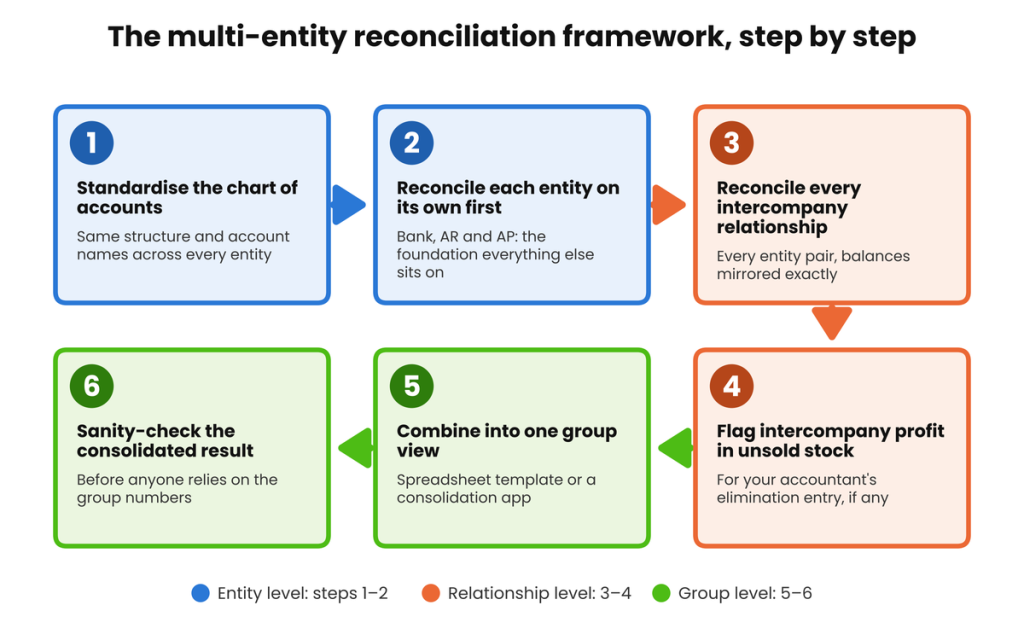
The six-step multi-entity reconciliation framework shown above, matched to Steps 1 through 6.
What Changes as a Group Grows
The framework above scales further than it might look. A two-entity group and a six-entity group are both running the same six steps. The difference is mostly in how many intercompany relationships exist in Step 3 and how much a consolidation tool in Step 5 starts to pay for itself. Here’s roughly how that shifts:
| Group size | Steps 1–4 workload | Step 5 approach that usually fits |
| 2 entities | One intercompany relationship to reconcile monthly. | Spreadsheet or even a simple shared document is usually enough. |
| 3–4 entities | Three to six intercompany relationships: map all of them, not just the obvious ones. | A structured spreadsheet template, reused every month rather than rebuilt. |
| 5+ entities, or frequent restructuring | Intercompany relationships start changing shape often enough that manual mapping becomes error-prone. | A consolidation app (Fathom, Syft, LiveFlow, Joiin) usually pays for itself in time saved. |
Where This Actually Goes Wrong
Most multi-entity consolidation problems trace back to a handful of repeat patterns, and most of them are easier to prevent than to untangle after the fact:
- Consolidating before every entity’s own accounts are individually reconciled. An error at entity level always resurfaces at group level, just harder to trace, so if the group total looks wrong, this is the first thing to rule out.
- Letting each entity keep its own chart-of-accounts naming. This turns every month’s consolidation into a fresh translation exercise, and a mismatched account-name mapping is the single most common cause of an otherwise-inexplicable group-level variance, so check for one here first if something’s off.
- Forgetting to map a less obvious intercompany relationship, like a shared bookkeeper’s time, a recharged software subscription, or an occasional loan between sister entities. These are easy to miss because they’re irregular, not because they’re small.
- Treating an intercompany relationship as reconciled once it’s close to zero rather than exactly zero. A small non-zero balance almost always traces back to one of the causes covered in our intercompany reconciliation guide.
- Ignoring intercompany profit sitting in unsold stock because “we don’t do formal consolidated accounts.” The profit is still not real from the group’s perspective even if nobody’s filing a consolidated statement this year.
- Forgetting to update the consolidation template when an entity is added or removed, or combining entities that operate in different currencies without translating their balances at a consistent rate and date first.
- Adopting an expensive consolidation tool because a vendor’s revenue threshold suggests you should, when a well-maintained spreadsheet still fits your actual number of entities and relationships.
- Treating the consolidated total as automatically correct just because it’s the last step. It inherits every error from the steps underneath it, so it needs its own sanity check, not blind trust.
If the group total still doesn’t look right after checking all of that, rebuild the consolidation one entity at a time: start with just two entities combined, confirm that’s right, then add the third, rather than troubleshooting all of them combined at once. For a systematic way to diagnose a discrepancy inside one entity’s own accounts before it ever reaches group level, see our guide on Common Reconciliation Discrepancies, and How to Fix Them (/common-reconciliation-discrepancies).
Multi-Entity Reconciliation Checklist
| ☐ | Confirm every entity uses the same chart-of-accounts structure and naming |
| ☐ | Reconcile each entity’s own bank accounts, AR and AP individually |
| ☐ | Map every intercompany relationship in the group, not just the obvious ones |
| ☐ | Reconcile every intercompany balance and confirm each nets to exactly zero once eliminated |
| ☐ | Flag any intercompany markup on goods or services still sitting in unsold stock or WIP |
| ☐ | Combine all entities into one group view using a consistent template or consolidation app |
| ☐ | Confirm the consolidated cash balance matches the sum of each entity’s actual bank balance |
| ☐ | Sanity-check consolidated revenue and profit before anyone relies on the numbers |
| ☐ | Document any elimination or correcting entries with a short explanatory note |
FAQs
What’s the difference between this framework and intercompany reconciliation?
Intercompany reconciliation is one relationship at a time: checking that Entity A’s and Entity B’s books agree on a specific loan or fee. This framework is the layer above it: standardising accounts across the whole group, reconciling every intercompany relationship, and then combining everything into one consolidated view.
Do I need a consolidation app, or is a spreadsheet enough?
For most groups of two to four entities with a handful of intercompany relationships, a well-built, reused spreadsheet template is genuinely enough. A consolidation app like Fathom, Syft, LiveFlow or Joiin starts to earn its cost once you’ve got five or more entities, frequent restructuring, or intercompany relationships changing shape often enough that manual mapping becomes error-prone.
Does QuickBooks Online or Xero do any of this automatically?
No. Each entity is a separate company file (QuickBooks Online) or organisation (Xero), and neither platform standardises charts of accounts or combines multiple entities into a group view on its own. Steps 1 and 5 of this framework are both manual or third-party-app-assisted.
What if two entities in the group use different account software, one QuickBooks Online, one Xero?
The framework still works. Step 1 (standardising the chart of accounts) matters even more, since you’re mapping account names across two different platforms as well as two different entities. Most consolidation apps in Step 5 are built to pull from both QuickBooks Online and Xero specifically for this reason.
How often should the whole framework be run?
Monthly, on the same cycle as your bank and intercompany reconciliations. Running it only at year end means a full year of small errors and mapping issues to untangle at once, rather than one month’s worth.
Do I need to eliminate intercompany profit in stock if my group doesn’t prepare consolidated financial statements?
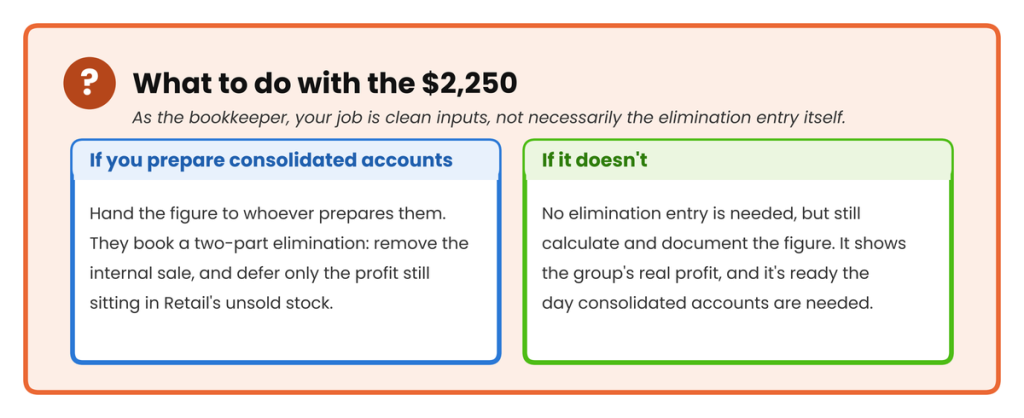
You don’t need to book a formal elimination entry if no one’s preparing consolidated accounts, but it’s still worth calculating and documenting the figure. It’s useful information for understanding the group’s real (not just combined) profitability, and it’s ready to hand over the day someone does need to prepare consolidated accounts.
What’s the most common reason a multi-entity consolidation doesn’t add up?
In practice, a mismatched chart-of-accounts mapping between entities causes more unexplained group-level variances than any other single issue, more than genuine intercompany errors. It’s worth checking first, before assuming something more complicated has gone wrong.
That $2,250.00, Found in Order
The Fernbridge Group’s $2,250.00 of unrealised profit sitting in Retail’s unsold stock wasn’t found by staring at a consolidated total until something looked wrong. It was found by working the framework in order: entities reconciled first, intercompany relationships second, and the group-level questions last.
That order is the whole point. A multi-entity reconciliation framework isn’t a bigger version of a single bank reconciliation. It’s a sequence that stops errors at the level they actually happened, instead of letting them surface as one confusing number at the very end. Run the same six steps every month, on the same schedule as your bank and intercompany reconciliations, and the group total stops being a mystery and starts being something you can actually stand behind.