
By Hiran, CIMA (ACMA, CGMA). 8+ years reconciling accounts across Australia, the UK, the US and Canada
If you run more than one company, maybe a holding company and an operating company, two sister businesses under common ownership, or a trust that owns the lot, sooner or later you’ll hit a number that doesn’t add up between them. One entity’s books say it’s owed $60,480. The other says it owes $59,840. Nobody’s stolen anything, and nothing’s technically “wrong” in either set of books on its own. But until someone reconciles the two, you don’t actually know your group’s real financial position, and neither does anyone you hand those books to.
That’s intercompany reconciliation. It gets a lot less coverage than ordinary bank reconciliation, and most of what’s written about it online is aimed at large corporations running formal consolidations across dozens of subsidiaries. This guide is aimed at the businesses I actually work with: a small group of two, three or four related entities, usually still on QuickBooks Online or Xero, where nobody’s filing a consolidated statement for the stock exchange, but the numbers still need to agree.
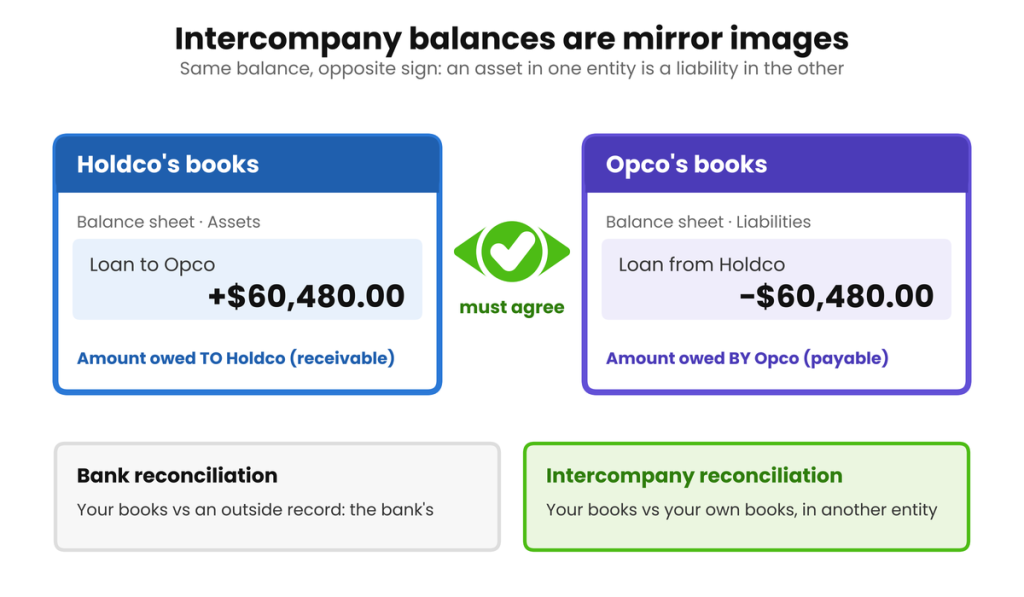
What Is Intercompany Reconciliation, in Plain English?
Intercompany reconciliation is the process of comparing a balance recorded in one related entity’s books against the mirror-image balance recorded in another related entity’s books, and working through any difference until the two agree exactly.
It’s a close cousin of bank reconciliation, but there’s an important difference in what you’re checking against. In a bank reconciliation, you’re comparing your books to an independent third party’s record: the bank’s. In an intercompany reconciliation, you’re comparing your own books to your own books, just kept in two different companies. Entity A’s “Loan to Entity B” account and Entity B’s “Loan from Entity A” account are supposed to be exact mirror images of the same relationship: same balance, opposite sign. When they’re not, one side (or both) has recorded something the other side hasn’t.
Why Intercompany Reconciliation Matters
- It stops a group from quietly overstating itself. Unreconciled intercompany transactions are one of the easiest ways for a group’s combined revenue or expenses to look bigger than they really are, because the same transaction is counted once as a sale on one side, but never fully matched as a cost on the other.
- It’s the first thing a lender, investor, or buyer’s accountant checks. If you’re seeking finance, bringing in an investor, or selling the business, intercompany balances that don’t reconcile are one of the fastest ways to lose credibility in due diligence. It signals the books haven’t been properly maintained, even if every individual entity’s accounts look fine on their own.
- It’s what your accountant needs at year end. Even if your group never files formal consolidated financial statements, your accountant still needs clean, agreed intercompany balances to prepare each entity’s own tax return correctly and to advise you accurately on the group’s real position.
- It catches genuine errors while they’re small. A $640 mismatch found in the month it happened is a five-minute fix. The same $640 error, left unreconciled for a year while more transactions pile on top of it, can take hours to unwind, and by then it’s often tangled up with two or three unrelated issues.
On one multi-entity engagement I worked on, a management fee that should have increased from $3,560 to $4,200 a month was still being invoiced at the old rate on one side, three months after the rate change took effect on the other. Nothing about either entity’s individual bank reconciliation would have caught it. Both bank accounts reconciled perfectly. It only surfaced because the intercompany loan account between the two entities was checked separately, line by line, against both ledgers.
Do You Actually Have to Do This?
This is the question most articles on this topic skip past, and it’s worth answering honestly. For most small groups, there’s no legal requirement to prepare formal consolidated financial statements at all. That doesn’t mean intercompany reconciliation is optional. It means the driver for doing it is good management information and clean tax filings, not a statutory filing deadline. Here’s how that plays out by country:
| Country | Do most small groups have to consolidate? | Where this comes from |
| Australia | Usually no. Most small proprietary companies aren’t required to prepare or lodge financial reports at all, let alone a consolidated one, unless ASIC directs it, shareholders holding the required threshold request it, or the company is foreign-controlled. | ASIC / Corporations Act 2001 |
| UK | Often no. A small group (broadly assessed on turnover, balance sheet total and employee numbers, two of three thresholds, two years running) can claim the small groups exemption from preparing consolidated group accounts. | Companies Act 2006, s399 |
| Canada | It’s a choice, not a default. Under ASPE, a private company can choose to either consolidate its subsidiaries or use the cost or equity method instead, as long as the same method is applied consistently to all of them. | CPA Canada ASPE, Section 1591 |
| US | No blanket small-business exemption, but no automatic requirement either. Most small private groups only need GAAP-basis consolidated statements when a lender, investor or bonding company specifically asks for them. | Lender / investor covenants |
This is a general guide, not advice on your specific structure. Check with your accountant once your group crosses any of these thresholds, takes on outside finance, or is preparing for sale. But for most small groups sitting below them, the honest answer to “do I have to consolidate” is no. What you still need, regardless, is intercompany accounts that agree with each other, because that’s true whether or not anyone ever asks you to formally consolidate.
Common Types of Intercompany Transactions
Almost every intercompany reconciliation issue traces back to one of these five transaction types:
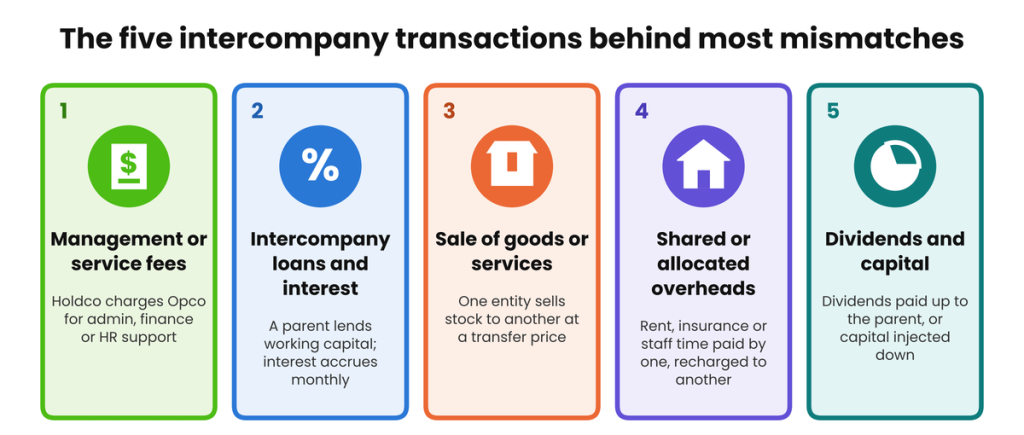
| Transaction type | Typical example | Where it usually lives |
| Management or service fees | A holding company charges an operating subsidiary for admin, finance or HR support it provides centrally. | Income (the entity charging) / expense or intercompany clearing (the entity being charged) |
| Intercompany loans and interest | A parent lends working capital to a newer subsidiary, with interest accruing monthly. | Loan receivable (the lender) / loan payable (the borrower) |
| Sale of goods or services between entities | A manufacturing entity sells stock to a related retail entity at an internal transfer price. | Sales (the seller) / inventory or cost of goods sold (the buyer) |
| Shared or allocated overheads | Rent, insurance or a shared bookkeeper’s time is paid by one entity and recharged to another. | Recharge income (the payer) / allocated expense (the recipient) |
| Dividends and capital contributions | A subsidiary declares a dividend up to its parent, or the parent injects capital down. | Dividend income / equity (the parent) / dividend payable / equity (the subsidiary) |
Why QuickBooks Online and Xero Don’t Do This For You
This surprises a lot of business owners: neither QuickBooks Online nor Xero has a native feature that automatically eliminates or reconciles intercompany balances across separate entities. Each related entity is its own company file in QuickBooks Online, or its own organisation in Xero, with its own separate ledger, and the two don’t talk to each other automatically.
Xero’s own product team has acknowledged this directly. A long-standing customer request for built-in multi-organisation consolidation has been open for over a decade with no committed timeline, and Xero’s stated position is that customers should use a third-party app for cross-organisation consolidation. QuickBooks Online Advanced offers some multi-entity dashboards and reporting tools, but it doesn’t automatically match or eliminate intercompany balances for you either. That part is still on you, or your bookkeeper.
In practice, this means two things for a small group:
- Set up a dedicated intercompany or clearing account in the chart of accounts of every entity involved. Never post an intercompany transaction straight to ordinary income or expense, because that hides it from this exact reconciliation.
- If you need consolidated reporting on a regular basis rather than just an annual exercise, a third-party consolidation app (options bookkeepers commonly use include Fathom, Syft Analytics, LiveFlow and Joiin) can pull multiple QuickBooks Online or Xero files into one combined report. But even these tools rely on your intercompany accounts already being reconciled and consistent going in. They report on the numbers; they don’t fix mismatches for you.
Two habits make this easier going forward. Keep a simple intercompany transactions policy, even one page, covering how fees are set and who updates both sides when a rate changes. And use the same chart-of-accounts structure and account names across every related entity where practical. Both make comparing balances far faster next time.
The Intercompany Reconciliation Process, Step by Step
We’ll walk through this with a worked example: the Bellcastle Group, made up of Bellcastle Holdings Pty Ltd (“Holdco”) and Bellcastle Trading Pty Ltd (“Opco”), reconciling their intercompany loan and management fee account for August 2026. The figures are illustrative, not a real client’s, but the method is exactly how a real intercompany reconciliation runs.
Step 1: Map Every Intercompany Relationship
List every pair of related entities that transact with each other, and what those transactions actually are. Bellcastle has one relationship to worry about: Holdco charges Opco a monthly management fee and has an intercompany loan outstanding to it, with interest accruing monthly. A group with more entities will have more of these pairs. Map all of them, not just the obvious one.
Step 2: Confirm a Dedicated Intercompany Account Exists on Both Sides
Bellcastle keeps a single combined intercompany control account on each entity’s balance sheet: “Loan to Opco” in Holdco’s books, “Loan from Holdco” in Opco’s books, capturing the loan principal, accrued interest, and the management fee together, rather than scattering them across separate accounts. For a simple two-entity structure like this, one combined account per counterparty is usually easier to reconcile than several. Larger or more active groups may need it split out by transaction type.
Step 3: Pull Each Entity’s Closing Balance
At 1 August 2026, both entities agreed the opening balance: $56,000.00. During August, two things happened on this account: Holdco’s management fee to Opco increased from $3,560.00 to $4,200.00 under a rate review that took effect 1 August, and interest of $280.00 accrued on the $56,000.00 opening balance at 6% p.a.
Holdco’s ledger for August shows: opening $56,000.00, plus the management fee of $4,200.00, plus interest of $280.00. Closing balance $60,480.00.
Opco’s ledger for August shows: opening $56,000.00, plus a management fee of $3,560.00, plus interest of $280.00. Closing balance $59,840.00.
Step 4: Compare the Two Balances
$60,480.00 on Holdco’s side against $59,840.00 on Opco’s side: a difference of $640.00. Since both entities recorded the same opening balance and the same interest accrual, the difference has to be sitting in the one line that doesn’t match: the management fee.
Step 5: Investigate the Difference
$4,200.00 minus $3,560.00 is exactly $640.00, so the entire gap traces to one cause. Opco’s recurring bill for the management fee was set up before the 1 August rate increase and was never updated, so it kept posting the old $3,560.00 amount even after Holdco started invoicing the new $4,200.00 rate. This is a genuinely common cause of intercompany mismatches: a rate or amount changes on one side’s recurring transaction template, and nobody remembers to update the mirror entry on the other side.
Step 6: Book the Correcting Entry and Document It
Opco books an additional $640.00 to the intercompany account, dated 31 August (the period the shortfall relates to, not the date it was found), bringing Opco’s closing balance to $59,840.00 + $640.00 = $60,480.00, now matching Holdco exactly. Opco also updates its recurring bill template to $4,200.00 so September doesn’t repeat the same error. A short note is saved with the reconciliation working paper explaining what happened and why, so if the same $640.00 pattern shows up again next month, whoever’s reconciling it doesn’t have to re-investigate from scratch.
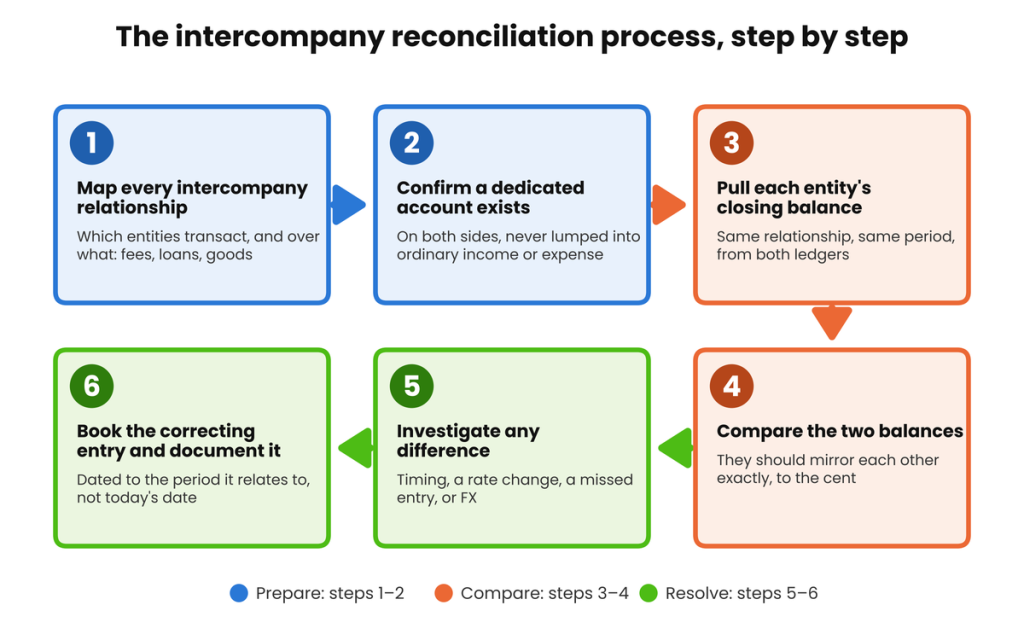
The six-step intercompany reconciliation process shown above, matched to Steps 1 through 6.
An Intercompany Reconciliation Example, Start to Finish
Here’s the Bellcastle Group’s August reconciliation condensed into one table:
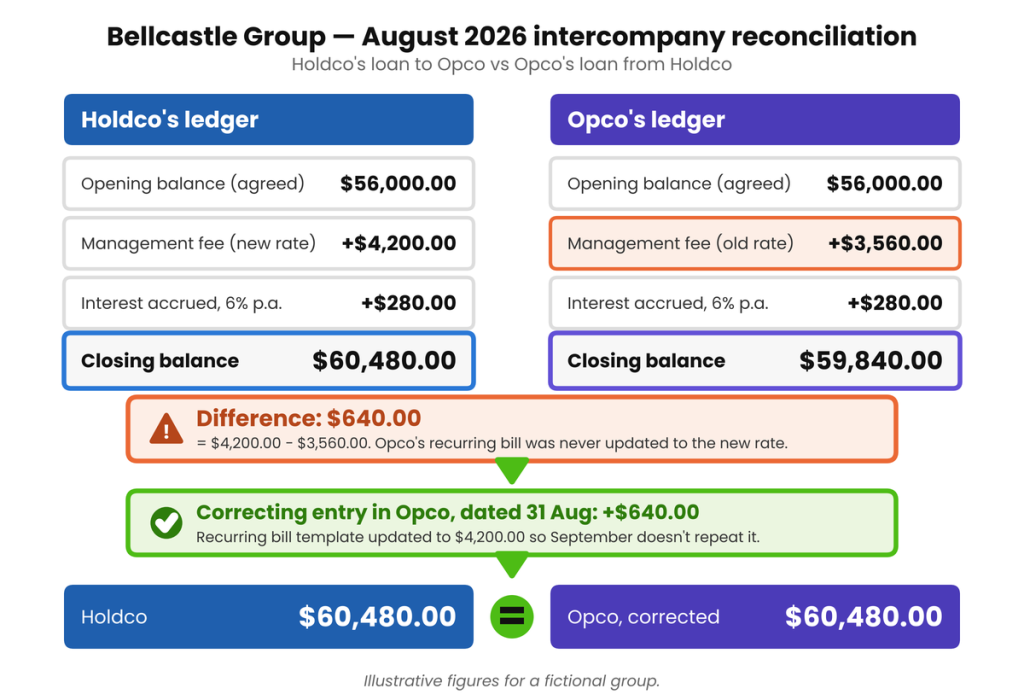
| Opening balance, 1 Aug (agreed) | $56,000.00 | Starting point, both sides |
| Holdco: management fee | +$4,200.00 | New rate, effective 1 Aug |
| Holdco: interest accrued | +$280.00 | 6% p.a. on $56,000.00 opening |
| = Holdco closing balance | $60,480.00 | |
| Opco: management fee (as recorded) | +$3,560.00 | Old rate, recurring bill not updated |
| Opco: interest accrued | +$280.00 | 6% p.a. on $56,000.00 opening |
| = Opco closing balance (before correction) | $59,840.00 | |
| Correcting entry, Opco | +$640.00 | Trues up the management fee to $4,200.00 |
| = Opco closing balance (after correction) | $60,480.00 |
Both entities land on $60,480.00. That’s an intercompany reconciliation example the way it actually runs on a real (if illustrative) set of accounts, start to finish.
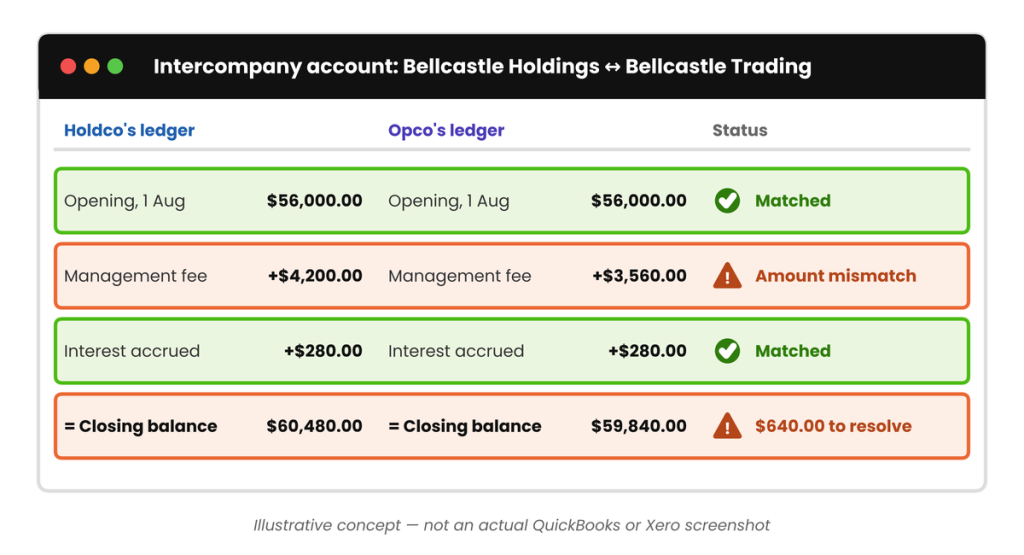
An illustrative concept of a matched versus flagged intercompany line. Not an actual QuickBooks or Xero screenshot.
What Bank Reconciliation and Intercompany Reconciliation Have in Common
If you’ve worked through a standard bank reconciliation before, the logic here will feel familiar. See the companion guide, How to Reconcile a Bank Statement, Step by Step, for the full method: confirm the opening position, compare the two records, investigate exactly where they diverge, and don’t call it done until both adjusted figures match to the cent. The only real difference is what you’re comparing against: an independent bank statement there, your own second set of books here.
Where This Actually Goes Wrong
Most intercompany mismatches trace back to a handful of repeat patterns, and the same disciplined approach that works for a bank reconciliation finds them here too.
- Posting an intercompany transaction straight to ordinary income or expense instead of a dedicated intercompany account. It distorts both entities’ individual profit and loss and hides the transaction from this exact reconciliation. Check for this by confirming whether a transaction was posted to ordinary income or expense on one side instead of the dedicated intercompany account. It will be invisible in this reconciliation but will show up as the group’s combined profit and loss not adding up the way you’d expect.
- Accruing interest or charging a fee on one side and forgetting to book the mirror entry on the other.
- Letting a recurring bill or invoice template go stale after a rate change. As in the Bellcastle example above, this is one of the single most common causes of a persistent, otherwise-mysterious intercompany gap. Check for a rate, amount or interest-rate change that was updated on one side’s recurring transaction but not the other’s.
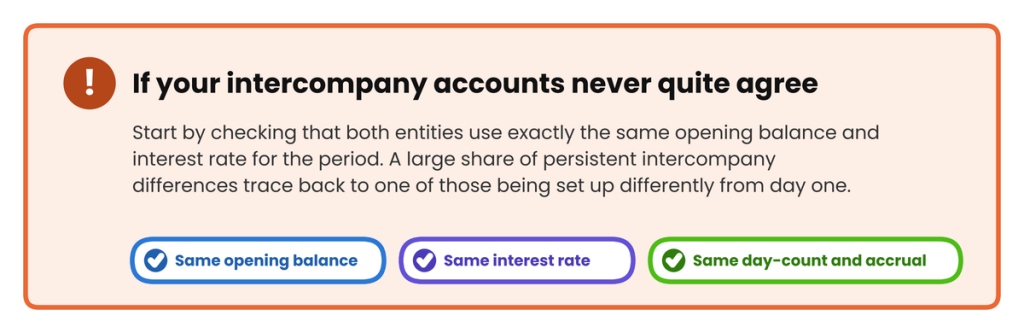
- Using a different interest rate, day-count convention, or accrual frequency on each side of the same loan.
- Netting off an intercompany balance to make it disappear from a report, without documenting why. This just moves the problem instead of solving it.
- Ignoring foreign exchange movement when the two entities operate in different currencies. The intercompany balance can shift even when no new transaction has occurred, simply because the exchange rate has. If this applies to you, check which exchange rate each side used to translate the balance; a stale or outdated rate is a common cause of small, persistent differences.
- Only reconciling intercompany accounts at year end instead of monthly, so a small monthly gap has months to compound before anyone looks at it.
If the two sides still won’t match once you’ve checked all of that, line up both entities’ intercompany ledgers side by side for the period and look at what appears on one side but not the other. Also check for a transaction booked in a different period on each side, such as Holdco recording August’s fee in August while Opco records it in September. That’s usually a timing difference, not an error, and it will self-correct once both sides catch up. Still stuck? Reconcile transaction by transaction for the period rather than balance to balance, the same principle as breaking a bank reconciliation down week by week when the whole-month figure won’t resolve.
Intercompany Reconciliation Checklist
| ☐ | List every pair of related entities that transact with each other, and over what |
| ☐ | Confirm a dedicated intercompany account exists in every entity’s chart of accounts |
| ☐ | Pull the closing balance for the same relationship and period from both entities’ books |
| ☐ | Compare the two balances: they should mirror each other exactly |
| ☐ | If they don’t match, check for a timing difference, a stale recurring transaction, an FX rate change, or a missed entry |
| ☐ | Confirm interest on any intercompany loan uses the same rate and day-count convention on both sides |
| ☐ | Book the correcting entry dated to the period it relates to, not the date it was found |
| ☐ | Update any recurring bill, invoice or journal template so the same error doesn’t repeat next period |
| ☐ | Document the resolution with the reconciliation working paper |
FAQs
What’s the difference between intercompany reconciliation and a normal bank reconciliation?
A bank reconciliation compares your books to an independent third party’s record: the bank’s. Intercompany reconciliation compares your own books to your own books, just kept in two different related entities. The method is similar; what you’re checking against is different.
Do I need to do this if I only have two related companies?
Yes. The number of entities doesn’t change whether the balances need to agree, only how much work it takes. A two-entity group with one management fee and one loan, like the Bellcastle example above, might take fifteen minutes a month once the accounts are set up properly.
Does QuickBooks Online or Xero do intercompany consolidation automatically?
No. Each entity is a separate company file (QuickBooks Online) or organisation (Xero), and neither platform automatically matches or eliminates intercompany balances across them. You need a dedicated intercompany account on each side and a manual, or third-party-app-assisted, reconciliation process.
Do small businesses legally have to prepare consolidated financial statements?
Usually not, in Australia, the UK and Canada, provided the group stays under the relevant size thresholds. See the comparison table earlier in this guide. In the US, it generally depends on whether a lender, investor or bonding company specifically requires GAAP-basis consolidated statements. Check with your accountant for your specific structure.
What’s an intercompany elimination, and do I need to worry about it if I don’t prepare consolidated accounts?
An elimination removes the effect of intercompany transactions (like an internal sale, or profit sitting in unsold inventory transferred between entities) when preparing a formal consolidated set of accounts, so the group doesn’t count the same revenue or profit twice. If you’re not preparing consolidated accounts, you don’t need to book eliminations, but it’s still worth flagging any internal markup to your accountant for the day you do.
How often should intercompany accounts be reconciled?
Monthly, on the same cycle as your bank reconciliations. A monthly cadence catches errors, like a stale recurring bill template, while they’re still a five-minute fix rather than a multi-month unwind.
What happens if the intercompany balances never match, no matter what I check?
Go back to basics: confirm both entities are using the same opening balance, the same interest rate and accrual method, and that every transaction type (fees, loans, recharges) is being captured on both sides. An intercompany account that’s persistently out is usually a sign that one side is missing an entire category of transaction, not just a single line.
That $640.00 Gap, Closed
The gap between Bellcastle Holdings and Bellcastle Trading wasn’t a mystery once someone looked. It was a management fee that increased on one side and never got updated on the other. That’s the whole discipline: give every intercompany relationship its own dedicated account, pull both sides’ closing balances every month, and don’t move on until they mirror each other exactly.
Whether or not your group ever files a formal consolidated statement, that habit is what keeps your numbers something you, and anyone you hand them to, can actually trust. The management-fee mismatch earlier in this guide wasn’t caught by either entity’s bank reconciliation; both reconciled perfectly on their own. It only surfaced because someone checked the intercompany account separately, line by line, against both ledgers. That’s still the job, however many entities you’re keeping straight.






[…] The Fernbridge Group has three intercompany relationships to check every month: Holdco charges a management fee and carries a loan balance with each of Manufacturing and Retail, and Manufacturing sells finished stock to Retail at a markup. Each of these gets reconciled the same way: pull the closing balance from both entities’ books, confirm they mirror each other exactly, and investigate anything that doesn’t. The full method, including a worked numeric example, is in What Is Intercompany Reconciliation, and Why It Matters. […]
[…] balances: covered in full in What Is Intercompany Reconciliation, and Why It Matters. A persistent mismatch between two related entities’ books almost always traces back to a […]